Author information
Cancer progression, as it was hypothesized a long time ago, could be due to the hybrid formation between primary tumor cells and tumor-infiltrating leucocytes, such as macrophages.1 In this concept, the metastatic cells gain the property of the leucocytes/macrophages’ motility phenotype. Interestingly, it was recently shown that non-metastatic mouse melanoma cells–macrophage fusion hybrids made in the laboratory show increased metastatic potential.2 In addition, Cloudman S91 non-metastatic melanoma cells displayed marked metastatic potential when injected into a mouse via the tail vein.3 The isolated clone showed increased motility in vitro, altered N-glycosylation, increased N-acetylglucosaminyltransferase-V (GnT-V) activity, and increased pigmentation, whereas the original non-metastatic melanoma cells were depigmented, non-motile, and did not overexpress GnT-V.3 In fact, GnT-V-generated β-1,6-branched polylactosamines are a common feature shared by normal granulocytes, monocytes, and some malignant cells.4 To understand the role of GnT-V, if any, in cancer metastasis, we reviewed the topic, collecting various up-to-date information and analyses to provide insights for cancer therapy.
The full name of GnT-V is N-acetylglucosaminyltransferase-V, and it is encoded by the MGAT5 gene. This enzyme transfers an N-acetylglucosamine (GlcNAc) residue from the high-energy donor UDP-GlcNAc to the α1-6-linked mannose of N-glycans via a β1-6 linkage.5,6 This β1-6 branch affects growth factor receptors to form clusters on the cell surface. It also affects cadherins and integrins to promote adhesion and migration by inhibiting the cis-dimerization of E-cadherin, resulting in cancer metastasis.7–12
Tissue-specific expression of GnT-V and its enzymatic product, β1,6-branched polylactosamines, has been found in normal granulocytes, monocytes, macrophages, lymphocytes, and a variety of malignant cells.13–21 Other cells, such as hypertrophic cardiomyocytes, myofibroblasts, normal human lung cells, and neural stem/progenitor cells, also express GnT-V and its enzymatic product, asparagine-linked oligosaccharides.22–26
As mentioned above, an elevated expression of GnT-V and its enzymatic product, the β1-6 GlcNAc branch, is found in various aggressive cancer cells,27–34 as well as in autoimmune diseases.35 According to research findings, GnT-V expression is particularly prominent in M2-type macrophages, which are CD163+, and in metastatic cancers.30–34,36 Experiments in the bleomycin-treated mouse model suggest that GnT-V promotes CD163+ macrophage accumulation in murine skin and therefore establishes an M(IL-4) phenotype, which refers to an M2 macrophage state that promotes anti-inflammatory functions.36
Further, the mRNA expression of GnT-V is driven by Ras-Raf-Ets oncogenes, which are upregulated in many types of cancers.37,38 Clinical studies have shown that increases in GnT-V activity are correlated with aggressiveness as well as tumor size, as observed in human breast cancer and colon cancer.39–42 These results strongly suggest that GnT-V may be playing an effective role in tumor malignancy.
To explain the macrophage’s motile phenotype, it could be mentioned that the interaction of oligosaccharides containing β-1-6 branching with its binding partner galectin-3 can activate macrophages and their motility.43,44 In addition, β1,6-GlcNAc branching driven by GnT-V is known to influence integrin-mediated cell adhesion, another macrophage phenotype.45–49
β-1-6 branching of Asn-linked oligosaccharides is directly associated with metastasis. Glycosylation mutants of a metastatic tumor cell line that were less metastatic in situ were also deficient in GnT-V expression and/or activity. Alternatively, when GnT-V and β-1-6 branching were increased in clones of a murine mammary carcinoma, they were found to be highly metastatic. These results indicate that increased β-1-6-linked branching on complex-type oligosaccharides, gp130, could be a marker of tumor progression.50
β-1,4-N-acetylglucosaminyltransferase (GnT-III), a competitive inhibitor of GnT-V, as their substrate is the same, when introduced into highly metastatic clonal B16 cells, reduces the affinity of the cells toward leuco-agglutinating phytohemagglutinin lectin, a marker of β-1-6 branching. This indicates that decreased expression of GnT-V and its enzymatic product makes the cells less invasive.51,52
GnT-V acts only on the α1-6 mannose branch of N-glycans. For instance, formation of bisecting GlcNAc by GnT-III completely interferes with GnT-V action (Fig. 1).53,54
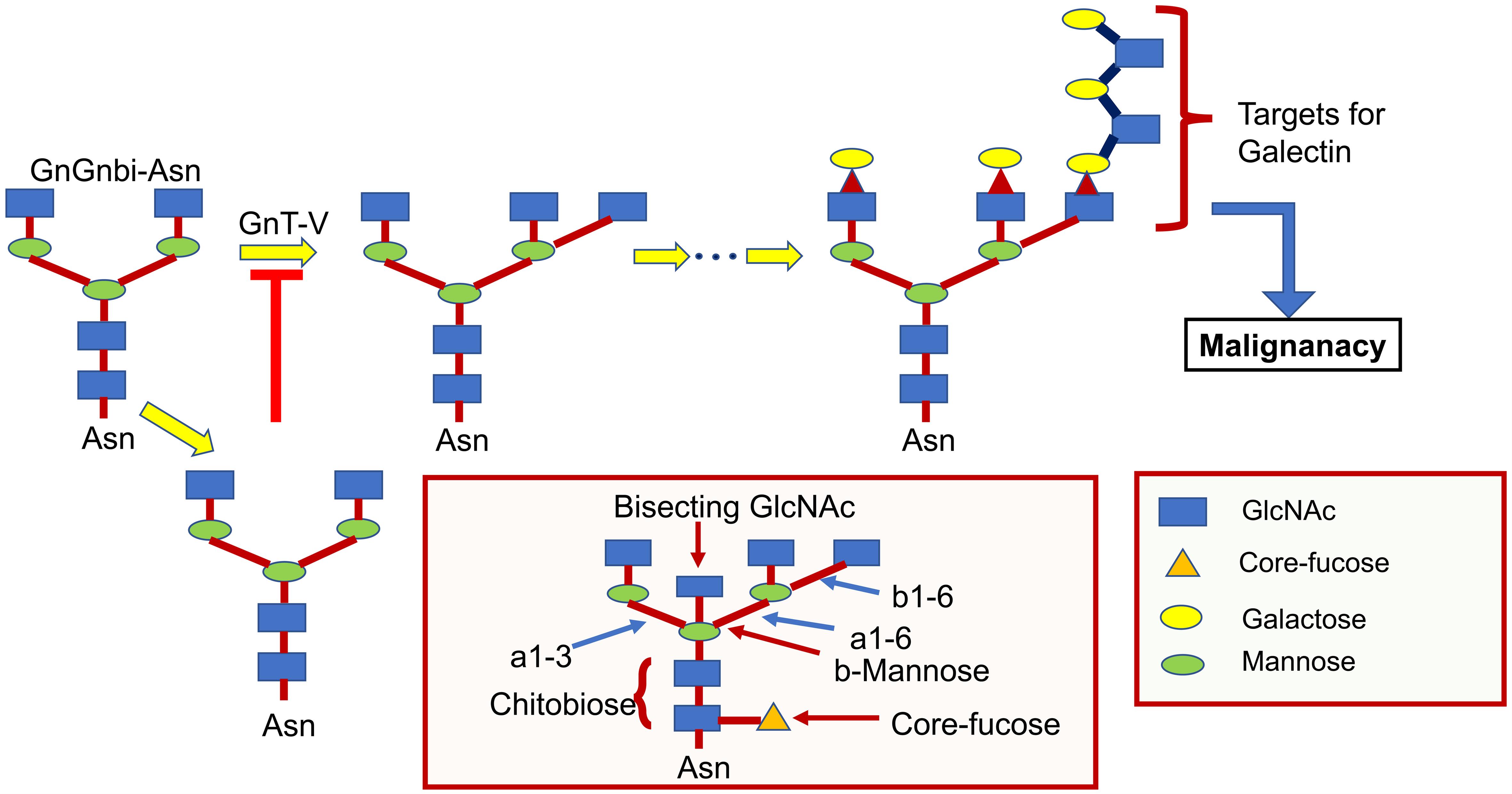
GnT-V transfection in a non-metastatic cancer cell line induces a dramatic increase in angiogenic activity. The reasons are:
production of angiogenic factors,
Changes in their function via the addition of β1–6 branching, a product of GnT-V.
However, the secreted type of GnT-V itself is able to induce angiogenesis with no detectable mediation of glycosylation. In addition, the basic domain in GnT-V can cause the direct release of FGF-2 from heparan sulfate proteoglycan on the cell surface and/or extracellular matrix. All these findings strongly suggest that GnT-V is a bifunctional protein, and the secreted type of GnT-V protein itself plays a role in tumor angiogenesis as an angiogenic cofactor of FGF-2.55
In a number of studies with rodent as well as human cancers, it is evident that the metastatic phenotype is directly associated with increased levels of β1,6-branched Asn-linked oligosaccharides.56,57 Rodent cells transformed with polyoma or Rous sarcoma virus, or transfected with H-ras oncogenes, result in increased β1,6-GlcNAc branching of complex-type oligosaccharides as well as increased polylactosamine content, a product of GnT-V.30 Further, the transformation of rat2 fibroblasts with T24H-ras, v-K-ras, or the tyrosine kinase oncogene vfps results in both increased GnT-V activity and invasiveness of the cells.58 In addition, tumor growth and metastasis were significantly suppressed in GnT-V knockout mice.59
Furthermore, reduced metastatic potential was also evident when the formation of β1,6-branched oligosaccharides was blocked by swainsonine.50,60 A similar effect on cancer progression was noted with overexpression of UDP-GlcNAc-α-D-mannoside-β1,6-N-acetylglucosaminyltransferase-III (GnT-III; EC 2.4.1.144), a competitive inhibitor of GnT-V.61 Tumors contain a varying number of macrophages. In human melanoma, the amount of tumor-associated macrophages ranges from 0 to 30% of the tumor volume.62–64 In some rat sarcomata, macrophage quantity was found to be as high as 60% of the tumor mass.65 Quantification of macrophage amounts in neoplastic lesions in situ was generally performed using a double-labeled histochemical method.66 Elevation of GnT-V transcription as well as its translation by various oncogenes, such as T24H-ras, v-K-ras, or the tyrosine kinase oncogene vfps, induces invasiveness and metastatic potential of various cancer cell lines.67 In addition, the loss of GnT-V activity in a glycosylation mutant of a highly metastatic cell line, MDAY-D2, was found to be associated with a loss of metastatic potential in mice.68
Reduced metastatic potential of highly invasive cancer cells was also documented when the formation of β1,6-branched oligosaccharides was blocked by pretreatment with swainsonine, a non-toxic inhibitor of β1,6-branched oligosaccharides.60,61,69,70 Further, overexpression of UDP-GlcNAc-α-D-mannoside-β1,6-N-acetylglucosaminyltransferase-III (GnT-III; EC 2.4.1.144), a competitive inhibitor of GnT-V, is able to reduce the invasive capacity of melanoma cell lines in vivo.52
In brief, an association between complex N-linked oligosaccharide expression, particularly β1,6 branch formation by overexpressed GnT-V, and metastatic potential has been established (for review, see references).14,52 Inevitably, TAMs, mainly of the M2 type, facilitate tumor proliferation, angiogenesis, invasion, and metastasis by releasing growth factors and cytokines, directly impacting survival, therapy resistance, and dissemination.71 Furthermore, the β1-6 branch on cadherins and integrins is overexpressed in tumors and therefore inhibits cell adhesion but increases tumor cell migration.72,73 Accumulating evidence, therefore, strongly suggests that β1-6 branch formation by GnT-V can promote cancer cell aggressiveness, and therefore any potential inhibitors of GnT-V could be feasible drug candidates for cancers.
In some studies, the positive correlation of high GnT-V expression with increased cancer metastasis was found only in 70% of cases.74 Further, the biological characteristics of tumors and the Ki-67 labeling index, a cancer marker, were higher in tumors with negative GnT-V expression, although the difference was not significant (P = 0.176). In oral squamous cell carcinoma, negative GnT-V expression was reported.74
Further, it has been suggested that not only GnT-V, but also other forms of glycosylation of proteins are related to cancer progression. A growing body of evidence suggests that aberrant glycosylation, such as fucosylation and sialylation, may also serve as potential cancer biomarkers for various cancer cells.75–80
AFP-L3 is a serum glycoprotein that carries a core-fucosylated (α1,6-fucosylated) glycan structure and has been widely used in the clinic to monitor hepatocellular carcinoma (HCC) surveillance. An AFP-L3% value greater than 10% indicates a high risk of HCC, while lower levels are generally linked to chronic liver disease.81 Recently, the fucosylation level of AFP and other proteins, including alpha-1-antitrypsin and Hp, was enhanced in HCC patients; thus, they might be promising liver cancer biomarker candidates.82,83 Sialylation usually occurs at the terminal of the glycan structure and has been found to be increased in HCC. Several groups have reported that the branching of glycan structures is related to HCC progression.83–85
Cancer metastasis is the main cause of the majority of cancer-related deaths. In vitro tumor models can only serve as low-cost cancer drug screening platforms, but cancer recurrence remains unchecked due to metastasis. The models should progress beyond simple proliferation, invasion, and cytotoxicity screens to measure intravasation, extravasation, angiogenesis, matrix remodeling, and tumor cell dormancy. Advances in tumor cell biology, 3D cell culture, tissue engineering, biomaterials, microfabrication, and microfluidics should be developed into new in vitro tumor models that incorporate multiple cell types, extracellular matrix materials, and the spatial and temporal introduction of soluble factors.
Future work may broaden our understanding of the role of the tumor microenvironment in cancer progression through the manipulation of physical cues and by coculturing with relevant cell types such as tumor-associated macrophages, neutrophils, and fibroblasts.
Further, the selection of the right in vitro model may allow researchers to recapitulate aspects of the tumor microenvironment using specific cell types, extracellular matrices, and soluble factors. There are some examples of useful model systems, such as hybrid models, wherein ex vivo tumor sections are embedded, and 3D invasion models, in which single cells are embedded in a 3D extracellular matrix. These can be used to study cancer growth, migration, extravasation, etc. Additional coculture of other relevant cell types within the surrounding matrix (e.g., tumor-associated macrophages, neutrophils, and fibroblasts) should also be included in future research.
Declarations
Acknowledgement
We acknowledge Allexcel, Inc. for encouraging this project and for support. Thanks to Ms. Julia Shiapong for her secretarial help.
Funding
No funding is provided for this project.
Conflict of interest
Dr. Ashok Chakraborty and Dr. Anil Diwan are both affiliated with Allexcel, Inc. The study received only moral support from AllExcel, and this is properly acknowledged.
Authors’ contributions
Conceptualization, literature review, and writing – original draft (AC), manuscript preparation , writing – review & editing (AD). Both the authors did contribute equally in writing this review.