Volume: 4 | Issue: 1 | View as PDF | Cite
  • OPEN ACCESS

GnT-V: Its Inhibition Can Inhibit Cancer Metastasis

  • Ashok Chakraborty*  and
  • Anil Diwan
 Author information
Nature Cell and Science   2026;4(1):e00029

doi: 10.61474/ncs.2025.00029

Cancer progression, as it was hypothesized a long time ago, could be due to the hybrid formation between primary tumor cells and tumor-infiltrating leucocytes, such as macrophages.1 In this concept, the metastatic cells gain the property of the leucocytes/macrophages’ motility phenotype. Interestingly, it was recently shown that non-metastatic mouse melanoma cells–macrophage fusion hybrids made in the laboratory show increased metastatic potential.2 In addition, Cloudman S91 non-metastatic melanoma cells displayed marked metastatic potential when injected into a mouse via the tail vein.3 The isolated clone showed increased motility in vitro, altered N-glycosylation, increased N-acetylglucosaminyltransferase-V (GnT-V) activity, and increased pigmentation, whereas the original non-metastatic melanoma cells were depigmented, non-motile, and did not overexpress GnT-V.3 In fact, GnT-V-generated β-1,6-branched polylactosamines are a common feature shared by normal granulocytes, monocytes, and some malignant cells.4 To understand the role of GnT-V, if any, in cancer metastasis, we reviewed the topic, collecting various up-to-date information and analyses to provide insights for cancer therapy.

The full name of GnT-V is N-acetylglucosaminyltransferase-V, and it is encoded by the MGAT5 gene. This enzyme transfers an N-acetylglucosamine (GlcNAc) residue from the high-energy donor UDP-GlcNAc to the α1-6-linked mannose of N-glycans via a β1-6 linkage.5,6 This β1-6 branch affects growth factor receptors to form clusters on the cell surface. It also affects cadherins and integrins to promote adhesion and migration by inhibiting the cis-dimerization of E-cadherin, resulting in cancer metastasis.7–12

Tissue-specific expression of GnT-V and its enzymatic product, β1,6-branched polylactosamines, has been found in normal granulocytes, monocytes, macrophages, lymphocytes, and a variety of malignant cells.13–21 Other cells, such as hypertrophic cardiomyocytes, myofibroblasts, normal human lung cells, and neural stem/progenitor cells, also express GnT-V and its enzymatic product, asparagine-linked oligosaccharides.22–26

As mentioned above, an elevated expression of GnT-V and its enzymatic product, the β1-6 GlcNAc branch, is found in various aggressive cancer cells,27–34 as well as in autoimmune diseases.35 According to research findings, GnT-V expression is particularly prominent in M2-type macrophages, which are CD163+, and in metastatic cancers.30–34,36 Experiments in the bleomycin-treated mouse model suggest that GnT-V promotes CD163+ macrophage accumulation in murine skin and therefore establishes an M(IL-4) phenotype, which refers to an M2 macrophage state that promotes anti-inflammatory functions.36

Further, the mRNA expression of GnT-V is driven by Ras-Raf-Ets oncogenes, which are upregulated in many types of cancers.37,38 Clinical studies have shown that increases in GnT-V activity are correlated with aggressiveness as well as tumor size, as observed in human breast cancer and colon cancer.39–42 These results strongly suggest that GnT-V may be playing an effective role in tumor malignancy.

To explain the macrophage’s motile phenotype, it could be mentioned that the interaction of oligosaccharides containing β-1-6 branching with its binding partner galectin-3 can activate macrophages and their motility.43,44 In addition, β1,6-GlcNAc branching driven by GnT-V is known to influence integrin-mediated cell adhesion, another macrophage phenotype.45–49

  • β-1-6 branching of Asn-linked oligosaccharides is directly associated with metastasis. Glycosylation mutants of a metastatic tumor cell line that were less metastatic in situ were also deficient in GnT-V expression and/or activity. Alternatively, when GnT-V and β-1-6 branching were increased in clones of a murine mammary carcinoma, they were found to be highly metastatic. These results indicate that increased β-1-6-linked branching on complex-type oligosaccharides, gp130, could be a marker of tumor progression.50

  • β-1,4-N-acetylglucosaminyltransferase (GnT-III), a competitive inhibitor of GnT-V, as their substrate is the same, when introduced into highly metastatic clonal B16 cells, reduces the affinity of the cells toward leuco-agglutinating phytohemagglutinin lectin, a marker of β-1-6 branching. This indicates that decreased expression of GnT-V and its enzymatic product makes the cells less invasive.51,52

GnT-V acts only on the α1-6 mannose branch of N-glycans. For instance, formation of bisecting GlcNAc by GnT-III completely interferes with GnT-V action (Fig. 1).53,54
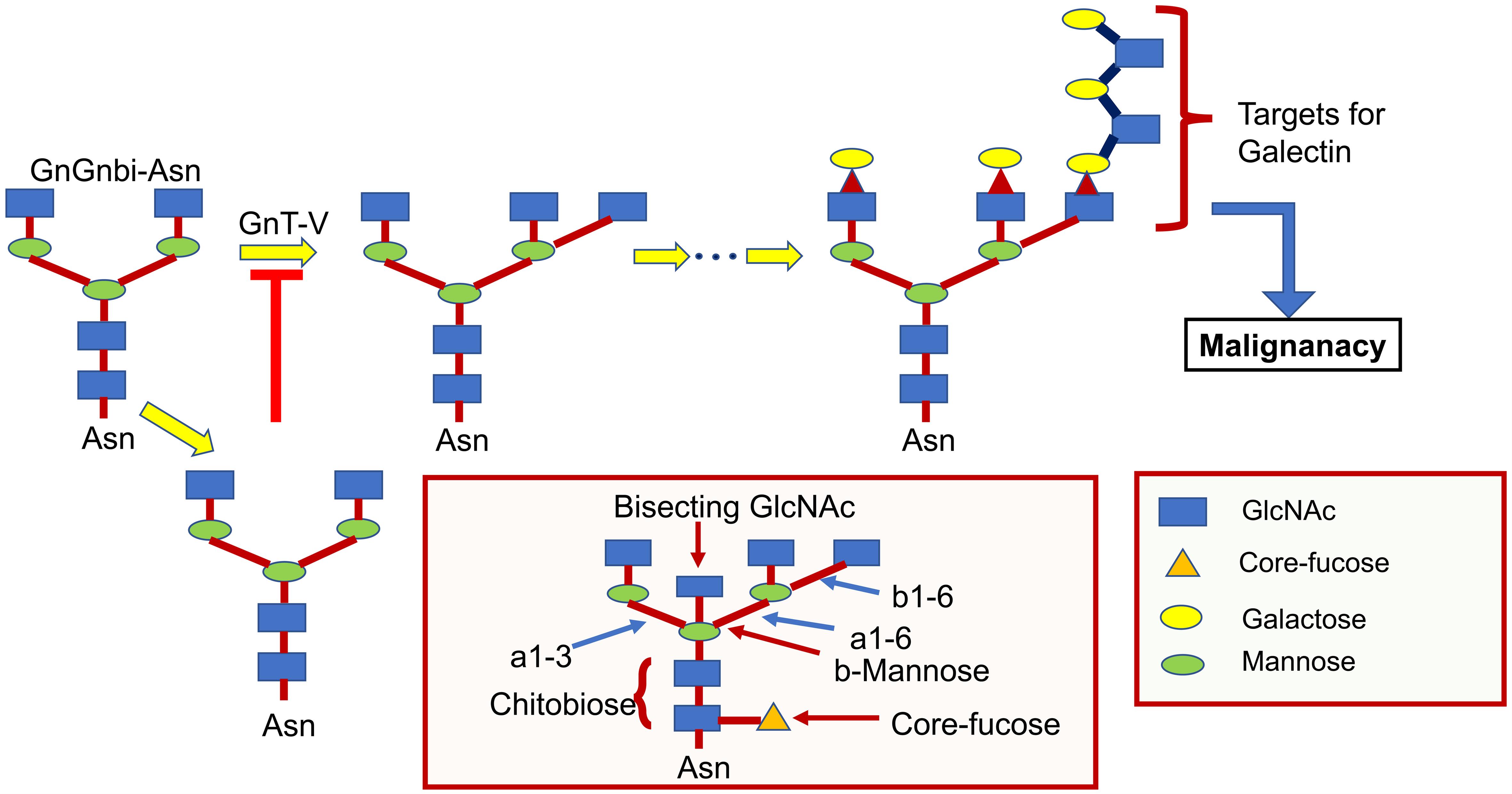
Inhibition of N-acetylglucosaminyltransferase-V (GnT-V) inhibits cancer metastasis.
Fig. 1  Inhibition of N-acetylglucosaminyltransferase-V (GnT-V) inhibits cancer metastasis.

GnT-V transfection in a non-metastatic cancer cell line induces a dramatic increase in angiogenic activity. The reasons are:

  • production of angiogenic factors,

  • Changes in their function via the addition of β1–6 branching, a product of GnT-V.

However, the secreted type of GnT-V itself is able to induce angiogenesis with no detectable mediation of glycosylation. In addition, the basic domain in GnT-V can cause the direct release of FGF-2 from heparan sulfate proteoglycan on the cell surface and/or extracellular matrix. All these findings strongly suggest that GnT-V is a bifunctional protein, and the secreted type of GnT-V protein itself plays a role in tumor angiogenesis as an angiogenic cofactor of FGF-2.55

In a number of studies with rodent as well as human cancers, it is evident that the metastatic phenotype is directly associated with increased levels of β1,6-branched Asn-linked oligosaccharides.56,57 Rodent cells transformed with polyoma or Rous sarcoma virus, or transfected with H-ras oncogenes, result in increased β1,6-GlcNAc branching of complex-type oligosaccharides as well as increased polylactosamine content, a product of GnT-V.30 Further, the transformation of rat2 fibroblasts with T24H-ras, v-K-ras, or the tyrosine kinase oncogene vfps results in both increased GnT-V activity and invasiveness of the cells.58 In addition, tumor growth and metastasis were significantly suppressed in GnT-V knockout mice.59

Furthermore, reduced metastatic potential was also evident when the formation of β1,6-branched oligosaccharides was blocked by swainsonine.50,60 A similar effect on cancer progression was noted with overexpression of UDP-GlcNAc-α-D-mannoside-β1,6-N-acetylglucosaminyltransferase-III (GnT-III; EC 2.4.1.144), a competitive inhibitor of GnT-V.61 Tumors contain a varying number of macrophages. In human melanoma, the amount of tumor-associated macrophages ranges from 0 to 30% of the tumor volume.62–64 In some rat sarcomata, macrophage quantity was found to be as high as 60% of the tumor mass.65 Quantification of macrophage amounts in neoplastic lesions in situ was generally performed using a double-labeled histochemical method.66 Elevation of GnT-V transcription as well as its translation by various oncogenes, such as T24H-ras, v-K-ras, or the tyrosine kinase oncogene vfps, induces invasiveness and metastatic potential of various cancer cell lines.67 In addition, the loss of GnT-V activity in a glycosylation mutant of a highly metastatic cell line, MDAY-D2, was found to be associated with a loss of metastatic potential in mice.68

Reduced metastatic potential of highly invasive cancer cells was also documented when the formation of β1,6-branched oligosaccharides was blocked by pretreatment with swainsonine, a non-toxic inhibitor of β1,6-branched oligosaccharides.60,61,69,70 Further, overexpression of UDP-GlcNAc-α-D-mannoside-β1,6-N-acetylglucosaminyltransferase-III (GnT-III; EC 2.4.1.144), a competitive inhibitor of GnT-V, is able to reduce the invasive capacity of melanoma cell lines in vivo.52

In brief, an association between complex N-linked oligosaccharide expression, particularly β1,6 branch formation by overexpressed GnT-V, and metastatic potential has been established (for review, see references).14,52 Inevitably, TAMs, mainly of the M2 type, facilitate tumor proliferation, angiogenesis, invasion, and metastasis by releasing growth factors and cytokines, directly impacting survival, therapy resistance, and dissemination.71 Furthermore, the β1-6 branch on cadherins and integrins is overexpressed in tumors and therefore inhibits cell adhesion but increases tumor cell migration.72,73 Accumulating evidence, therefore, strongly suggests that β1-6 branch formation by GnT-V can promote cancer cell aggressiveness, and therefore any potential inhibitors of GnT-V could be feasible drug candidates for cancers.

In some studies, the positive correlation of high GnT-V expression with increased cancer metastasis was found only in 70% of cases.74 Further, the biological characteristics of tumors and the Ki-67 labeling index, a cancer marker, were higher in tumors with negative GnT-V expression, although the difference was not significant (P = 0.176). In oral squamous cell carcinoma, negative GnT-V expression was reported.74

Further, it has been suggested that not only GnT-V, but also other forms of glycosylation of proteins are related to cancer progression. A growing body of evidence suggests that aberrant glycosylation, such as fucosylation and sialylation, may also serve as potential cancer biomarkers for various cancer cells.75–80

AFP-L3 is a serum glycoprotein that carries a core-fucosylated (α1,6-fucosylated) glycan structure and has been widely used in the clinic to monitor hepatocellular carcinoma (HCC) surveillance. An AFP-L3% value greater than 10% indicates a high risk of HCC, while lower levels are generally linked to chronic liver disease.81 Recently, the fucosylation level of AFP and other proteins, including alpha-1-antitrypsin and Hp, was enhanced in HCC patients; thus, they might be promising liver cancer biomarker candidates.82,83 Sialylation usually occurs at the terminal of the glycan structure and has been found to be increased in HCC. Several groups have reported that the branching of glycan structures is related to HCC progression.83–85

Cancer metastasis is the main cause of the majority of cancer-related deaths. In vitro tumor models can only serve as low-cost cancer drug screening platforms, but cancer recurrence remains unchecked due to metastasis. The models should progress beyond simple proliferation, invasion, and cytotoxicity screens to measure intravasation, extravasation, angiogenesis, matrix remodeling, and tumor cell dormancy. Advances in tumor cell biology, 3D cell culture, tissue engineering, biomaterials, microfabrication, and microfluidics should be developed into new in vitro tumor models that incorporate multiple cell types, extracellular matrix materials, and the spatial and temporal introduction of soluble factors.

Future work may broaden our understanding of the role of the tumor microenvironment in cancer progression through the manipulation of physical cues and by coculturing with relevant cell types such as tumor-associated macrophages, neutrophils, and fibroblasts.

Further, the selection of the right in vitro model may allow researchers to recapitulate aspects of the tumor microenvironment using specific cell types, extracellular matrices, and soluble factors. There are some examples of useful model systems, such as hybrid models, wherein ex vivo tumor sections are embedded, and 3D invasion models, in which single cells are embedded in a 3D extracellular matrix. These can be used to study cancer growth, migration, extravasation, etc. Additional coculture of other relevant cell types within the surrounding matrix (e.g., tumor-associated macrophages, neutrophils, and fibroblasts) should also be included in future research.

Declarations

Acknowledgement

We acknowledge Allexcel, Inc. for encouraging this project and for support. Thanks to Ms. Julia Shiapong for her secretarial help.

Funding

No funding is provided for this project.

Conflict of interest

Dr. Ashok Chakraborty and Dr. Anil Diwan are both affiliated with Allexcel, Inc. The study received only moral support from AllExcel, and this is properly acknowledged.

Authors’ contributions

Conceptualization, literature review, and writing – original draft (AC), manuscript preparation , writing – review & editing (AD). Both the authors did contribute equally in writing this review.

References

  1. López-Collazo E, Hurtado-Navarro L. Cell fusion as a driver of metastasis: re-evaluating an old hypothesis in the age of cancer heterogeneity. Front Immunol 2025;16:1524781 View Article PubMed/NCBI
  2. Li M, Basile JR, Mallya S, Lin YL. The impact and outcomes of cancer-macrophage fusion. BMC Cancer 2023;23(1):497 View Article PubMed/NCBI
  3. Pawelek JM, Chakraborty AK. The cancer cell—leukocyte fusion theory of metastasis. Adv Cancer Res 2008;101:397-444 View Article PubMed/NCBI
  4. Chakraborty AK, Pawelek J, Ikeda Y, Miyoshi E, Kolesnikova N, Funasaka Y, et al. Fusion hybrids with macrophage and melanoma cells up-regulate N-acetylglucosaminyltransferase V, beta1-6 branching, and metastasis. Cell Growth Differ 2001;12(12):623-630 PubMed/NCBI
  5. Maeda K, Taniguchi N. Enzyme assay of N-acetylglucosaminyltransferase-V (GnT-V, MGAT5). In: Nishihara S, Angata K, Aoki-Kinoshita KF, Hirabayashi J (eds). Glycoscience Protocols(GlycoPODv2). Saitama (JP): Japan Consortium for Glycobiology and Glycotechnology; 2021. Available from: https://www.ncbi.nlm.nih.gov/books/NBK593855/
  6. Nagae M, Kizuka Y, Mihara E, Kitago Y, Hanashima S, Ito Y, et al. Structure and mechanism of cancer-associated N-acetylglucosaminyltransferase-V. Nat Commun 2018;9(1):3380 View Article PubMed/NCBI
  7. Osuka RF, Hirata T, Nagae M, Nakano M, Shibata H, Okamoto R, et al. N-acetylglucosaminyltransferase-V requires a specific noncatalytic luminal domain for its activity toward glycoprotein substrates. J Biol Chem 2022;298(3):101666 View Article PubMed/NCBI
  8. Hirata T, Harada Y, Hirosawa KM, Tokoro Y, Suzuki KGN, Kizuka Y. N-acetylglucosaminyltransferase-V (GnT-V)-enriched small extracellular vesicles mediate N-glycan remodeling in recipient cells. iScience 2023;26(1):105747 View Article PubMed/NCBI
  9. Osuka RF, Nagae M, Ohuchi A, Ohno S, Yamaguchi Y, Kizuka Y. The cancer-associated glycosyltransferase GnT-V (MGAT5) recognizes the N-glycan core via residues outside its catalytic pocket. FEBS Lett 2023;597(24):3102-3113 View Article PubMed/NCBI
  10. Kozlova I, Sytnyk V. Cell Adhesion Molecules as Modulators of the Epidermal Growth Factor Receptor. Cells 2024;13(22):1919 View Article PubMed/NCBI
  11. Ferreira IG, Pucci M, Venturi G, Malagolini N, Chiricolo M, Dall'Olio F. Glycosylation as a Main Regulator of Growth and Death Factor Receptors Signaling. Int J Mol Sci 2018;19(2):580 View Article PubMed/NCBI
  12. Pinho SS, Seruca R, Gärtner F, Yamaguchi Y, Gu J, Taniguchi N, et al. Modulation of E-cadherin function and dysfunction by N-glycosylation. Cell Mol Life Sci 2011;68(6):1011-1020 View Article PubMed/NCBI
  13. Dosaka-Akita H, Miyoshi E, Suzuki O, Itoh T, Katoh H, Taniguchi N. Expression of N-acetylglucosaminyltransferase v is associated with prognosis and histology in non-small cell lung cancers. Clin Cancer Res 2004;10(5):1773-1779 View Article PubMed/NCBI
  14. Chakraborty AK, Pawelek JM. GnT-V, macrophage and cancer metastasis: a common link. Clin Exp Metastasis 2003;20(4):365-373 View Article PubMed/NCBI
  15. Partridge EA, Le Roy C, Di Guglielmo GM, Pawling J, Cheung P, Granovsky M, et al. Regulation of cytokine receptors by Golgi N-glycan processing and endocytosis. Science 2004;306(5693):120-124 View Article PubMed/NCBI
  16. Padhiar AA, Fan J, Tang Y, Yu J, Wang S, Liu L, et al. Upregulated β1-6 branch N-glycan marks early gliomagenesis but exhibited biphasic expression in the progression of astrocytic glioma. Am J Cancer Res 2015;5(3):1101-1116 PubMed/NCBI
  17. da Costa V, Freire T. Advances in the Immunomodulatory Properties of Glycoantigens in Cancer. Cancers (Basel) 2022;14(8):1854 View Article PubMed/NCBI
  18. Hussein MR. Tumour-associated macrophages and melanoma tumourigenesis: integrating the complexity. Int J Exp Pathol 2006;87(3):163-176 View Article PubMed/NCBI
  19. Ha ES, Hwang SH, Shin KS, Yu KW, Lee KH, Choi JS, et al. Anti-metastatic activity of glycoprotein fractionated from Acanthopanax senticosus, involvement of NK-cell and macrophage activation. Arch Pharm Res 2004;27(2):217-224 View Article PubMed/NCBI
  20. Kamiryo Y, Yajima T, Saito K, Nishimura H, Fushimi T, Ohshima Y, et al. Soluble branched (1,4)-beta-D-glucans from Acetobacter species enhance antitumor activities against MHC class I-negative and -positive malignant melanoma through augmented NK activity and cytotoxic T-cell response. Int J Cancer 2005;115(5):769-776 View Article PubMed/NCBI
  21. Hirata T, Takata M, Tokoro Y, Nakano M, Kizuka Y. Shedding of N-acetylglucosaminyltransferase-V is regulated by maturity of cellular N-glycan. Commun Biol 2022;5(1):743 View Article PubMed/NCBI
  22. Kizuka Y, Kitazume S, Okahara K, Villagra A, Sotomayor EM, Taniguchi N. Epigenetic regulation of a brain-specific glycosyltransferase N-acetylglucosaminyltransferase-IX (GnT-IX) by specific chromatin modifiers. J Biol Chem 2014;289(16):11253-11261 View Article PubMed/NCBI
  23. van den Dolder FW, Dinani R, Warnaar VAJ, Vučković S, Passadouro AS, Nassar AA, et al. Experimental Models of Hypertrophic Cardiomyopathy: A Systematic Review. JACC Basic Transl Sci 2025;10(4):511-546 View Article PubMed/NCBI
  24. Zhao R, Hu J, Wen H, Zhao J, Wang Y, Niu X, et al. Inhibition of N-acetylglucosaminyltransferase V alleviates diabetic cardiomyopathy in mice by attenuating cardiac hypertrophy and fibrosis. Nutr Metab (Lond) 2024;21(1):53 View Article PubMed/NCBI
  25. Hamanoue M, Ikeda Y, Ogata T, Takamatsu K. Predominant expression of N-acetylglucosaminyltransferase V (GnT-V) in neural stem/progenitor cells. Stem Cell Res 2015;14(1):68-78 View Article PubMed/NCBI
  26. Kimura K, Koizumi T, Urasawa T, Ohta Y, Takakura D, Kawasaki N. Glycoproteomic analysis of the changes in protein N-glycosylation during neuronal differentiation in human-induced pluripotent stem cells and derived neuronal cells. Sci Rep 2021;11(1):11169 View Article PubMed/NCBI
  27. Kariya Y, Oyama M, Ohtsuka M, Kikuchi N, Hashimoto Y, Yamamoto T. Quantitative analysis of β1,6GlcNAc-branched N-glycans on β4 integrin in cutaneous squamous cell carcinoma. Fukushima J Med Sci 2020;66(3):119-123 View Article PubMed/NCBI
  28. Kariya Y, Kariya Y, Gu J. Laminin-332 and integrins: signaling platform for cell adhesion and migration and its regulation by N-glycosylation. In: Adams DC, Garcia EO (eds). Laminins: Structure, Biological Activity and Role in Disease. New York (NY): Nova Science Publishers; 2013:29-51
  29. Kariya Y, Kariya Y, Gu J. Roles of Integrin α6β4 Glycosylation in Cancer. Cancers (Basel) 2017;9(7):79 View Article PubMed/NCBI
  30. Kizuka Y, Taniguchi N. Enzymes for N-Glycan Branching and Their Genetic and Nongenetic Regulation in Cancer. Biomolecules 2016;6(2):25 View Article PubMed/NCBI
  31. Huang B, Sun L, Cao J, Zhang Y, Wu Q, Zhang J, et al. Downregulation of the GnT-V gene inhibits metastasis and invasion of BGC823 gastric cancer cells. Oncol Rep 2013;29(6):2392-2400 View Article PubMed/NCBI
  32. Ishimura H, Takahashi T, Nakagawa H, Nishimura S, Arai Y, Horikawa Y, et al. N-acetylglucosaminyltransferase V and beta1-6 branching N-linked oligosaccharides are associated with good prognosis of patients with bladder cancer. Clin Cancer Res 2006;12(8):2506-2511 View Article PubMed/NCBI
  33. Tian H, Miyoshi E, Kawaguchi N, Shaker M, Ito Y, Taniguchi N, et al. The implication of N-acetylglucosaminyltransferase V expression in gastric cancer. Pathobiology 2008;75(5):288-294 View Article PubMed/NCBI
  34. Kato A, Yutani M, Terao M, Kimura A, Itoi S, Murota H, et al. Oligosaccharide modification by N-acetylglucosaminyltransferase-V in macrophages are involved in pathogenesis of bleomycin-induced scleroderma. Exp Dermatol 2015;24(8):585-590 View Article PubMed/NCBI
  35. Varki A. Biological roles of glycans. Glycobiology 2017;27(1):3-49 View Article PubMed/NCBI
  36. Zhao L, Yan F, Tang D, Li W, An N, Ren C, et al. The transition between M1 and M2 macrophage phenotypes is associated with the disease status following CD19 CAR-T therapy for B cell lymphoma/leukemia. Cell Death Dis 2025;16(1):275 View Article PubMed/NCBI
  37. Osuka RF, Yamasaki T, Kizuka Y. Structure and function of N-acetylglucosaminyltransferase V (GnT-V). Biochim Biophys Acta Gen Subj 2024;1868(11):130709 View Article PubMed/NCBI
  38. Yang X, Wu H. RAS signaling in carcinogenesis, cancer therapy and resistance mechanisms. J Hematol Oncol 2024;17(1):108 View Article PubMed/NCBI
  39. Saito T, Miyoshi E, Sasai K, Nakano N, Eguchi H, Honke K, et al. A secreted type of beta 1,6-N-acetylglucosaminyltransferase V (GnT-V) induces tumor angiogenesis without mediation of glycosylation: a novel function of GnT-V distinct from the original glycosyltransferase activity. J Biol Chem 2002;277(19):17002-17008 View Article PubMed/NCBI
  40. Darby JF, Gilio AK, Piniello B, Roth C, Blagova E, Hubbard RE, et al. Substrate engagement and catalytic mechanisms of N-acetylglucosaminyltransferase V. ACS Catal 2020;10(15):8590-8596 View Article
  41. Miao Z, Cao Q, Liao R, Chen X, Li X, Bai L, et al. Elevated transcription and glycosylation of B3GNT5 promotes breast cancer aggressiveness. J Exp Clin Cancer Res 2022;41(1):169 View Article PubMed/NCBI
  42. Scott DA, Casadonte R, Cardinali B, Spruill L, Mehta AS, Carli F, et al. Increases in Tumor N-Glycan Polylactosamines Associated with Advanced HER2-Positive and Triple-Negative Breast Cancer Tissues. Proteomics Clin Appl 2019;13(1):e1800014 View Article PubMed/NCBI
  43. Collins PM, Bum-Erdene K, Yu X, Blanchard H. Galectin-3 interactions with glycosphingolipids. J Mol Biol 2014;426(7):1439-1451 View Article PubMed/NCBI
  44. Hind LE, Dembo M, Hammer DA. Macrophage motility is driven by frontal-towing with a force magnitude dependent on substrate stiffness. Integr Biol (Camb) 2015;7(4):447-453 View Article PubMed/NCBI
  45. Li N, Xu H, Fan K, Liu X, Qi J, Zhao C, et al. Altered β1,6-GlcNAc branched N-glycans impair TGF-β-mediated epithelial-to-mesenchymal transition through Smad signalling pathway in human lung cancer. J Cell Mol Med 2014;18(10):1975-1991 View Article PubMed/NCBI
  46. Huang HW, Chang CC, Wang CS, Lin KH. Association between Inflammation and Function of Cell Adhesion Molecules Influence on Gastrointestinal Cancer Development. Cells 2021;10(1):67 View Article PubMed/NCBI
  47. Wang L, Liang Y, Li Z, Cai X, Zhang W, Wu G, et al. Increase in beta1-6 GlcNAc branching caused by N-acetylglucosaminyltransferase V directs integrin beta1 stability in human hepatocellular carcinoma cell line SMMC-7721. J Cell Biochem 2007;100(1):230-241 View Article PubMed/NCBI
  48. McWhorter FY, Wang T, Nguyen P, Chung T, Liu WF. Modulation of macrophage phenotype by cell shape. Proc Natl Acad Sci U S A 2013;110(43):17253-17258 View Article PubMed/NCBI
  49. Isaji T, Kariya Y, Xu Q, Fukuda T, Taniguchi N, Gu J. Functional roles of the bisecting GlcNAc in integrin-mediated cell adhesion. Methods Enzymol 2010;480:445-459 View Article PubMed/NCBI
  50. da Fonseca LM, da Silva VA, Freire-de-Lima L, Previato JO, Mendonça-Previato L, Capella MA. Glycosylation in Cancer: Interplay between Multidrug Resistance and Epithelial-to-Mesenchymal Transition?. Front Oncol 2016;6:158 View Article PubMed/NCBI
  51. Bojar D, Meche L, Meng G, Eng W, Smith DF, Cummings RD, et al. A Useful Guide to Lectin Binding: Machine-Learning Directed Annotation of 57 Unique Lectin Specificities. ACS Chem Biol 2022;17(11):2993-3012 View Article PubMed/NCBI
  52. Brooks S. Lectins as versatile tools to explore cellular glycosylation. Eur J Histochem 2024;68(1):3959 View Article PubMed/NCBI
  53. Nakano M, Mishra SK, Tokoro Y, Sato K, Nakajima K, Yamaguchi Y, et al. Bisecting GlcNAc Is a General Suppressor of Terminal Modification of N-glycan. Mol Cell Proteomics 2019;18(10):2044-2057 View Article PubMed/NCBI
  54. Zhao Y, Nakagawa T, Itoh S, Inamori K, Isaji T, Kariya Y, et al. N-acetylglucosaminyltransferase III antagonizes the effect of N-acetylglucosaminyltransferase V on alpha3beta1 integrin-mediated cell migration. J Biol Chem 2006;281(43):32122-32130 View Article PubMed/NCBI
  55. Nakahara S, Saito T, Kondo N, Moriwaki K, Noda K, Ihara S, et al. A secreted type of beta1,6 N-acetylglucosaminyltransferase V (GnT-V), a novel angiogenesis inducer, is regulated by gamma-secretase. FASEB J 2006;20(14):2451-2459 View Article
  56. Feng Y, Qiao S, Chen J, Wen X, Chen Y, Song X, et al. M2-Type Macrophages and Cancer-Associated Fibroblasts Combine to Promote Colorectal Cancer Liver Metastases. Onco Targets Ther 2024;17:243-260 View Article PubMed/NCBI
  57. Tian H, Lyu Y, Yang YG, Hu Z. Humanized Rodent Models for Cancer Research. Front Oncol 2020;10:1696 View Article PubMed/NCBI
  58. Regad T. Targeting RTK Signaling Pathways in Cancer. Cancers (Basel) 2015;7(3):1758-1784 View Article PubMed/NCBI
  59. Lin Y, Xu J, Lan H. Tumor-associated macrophages in tumor metastasis: biological roles and clinical therapeutic applications. J Hematol Oncol 2019;12(1):76 View Article PubMed/NCBI
  60. de-Souza-Ferreira M, Ferreira ÉE, de-Freitas-Junior JCM. Aberrant N-glycosylation in cancer: MGAT5 and β1,6-GlcNAc branched N-glycans as critical regulators of tumor development and progression. Cell Oncol (Dordr) 2023;46(3):481-501 View Article PubMed/NCBI
  61. Vibhute AM, Tanaka HN, Mishra SK, Osuka RF, Nagae M, Yonekawa C, et al. Structure-based design of UDP-GlcNAc analogs as candidate GnT-V inhibitors. Biochim Biophys Acta Gen Subj 2022;1866(6):130118 View Article PubMed/NCBI
  62. Pittet MJ, Michielin O, Migliorini D. Clinical relevance of tumour-associated macrophages. Nat Rev Clin Oncol 2022;19(6):402-421 View Article PubMed/NCBI
  63. Pizzurro GA, Bridges K, Jiang X, Vidyarthi A, Miller-Jensen K, Colegio OR. Functionally and Metabolically Divergent Melanoma-Associated Macrophages Originate from Common Bone-Marrow Precursors. Cancers (Basel) 2023;15(13):3330 View Article PubMed/NCBI
  64. Li S, Yu J, Huber A, Kryczek I, Wang Z, Jiang L, et al. Metabolism drives macrophage heterogeneity in the tumor microenvironment. Cell Rep 2022;39(1):110609 View Article PubMed/NCBI
  65. Christofides A, Strauss L, Yeo A, Cao C, Charest A, Boussiotis VA. The complex role of tumor-infiltrating macrophages. Nat Immunol 2022;23(8):1148-1156 View Article PubMed/NCBI
  66. Coulton A, Murai J, Qian D, Thakkar K, Lewis CE, Litchfield K. Using a pan-cancer atlas to investigate tumour associated macrophages as regulators of immunotherapy response. Nat Commun 2024;15(1):5665 View Article PubMed/NCBI
  67. Pierce M, Buckhaults P, Chen L, Fregien N. Regulation of N-acetylglucosaminyltransferase V and Asn-linked oligosaccharide beta(1,6) branching by a growth factor signaling pathway and effects on cell adhesion and metastatic potential. Glycoconj J 1997;14(5):623-630 View Article PubMed/NCBI
  68. Hollander EE, Flock RE, McDevitt JC, Vostrejs WP, Campbell SL, Orlen MI, et al. N-glycosylation by Mgat5 imposes a targetable constraint on immune-mediated tumor clearance. JCI Insight 2024;9(12):e178804 View Article PubMed/NCBI
  69. Li Y, Liu F, Cai Q, Deng L, Ouyang Q, Zhang XH, et al. Invasion and metastasis in cancer: molecular insights and therapeutic targets. Signal Transduct Target Ther 2025;10(1):57 View Article PubMed/NCBI
  70. Häuselmann I, Borsig L. Altered tumor-cell glycosylation promotes metastasis. Front Oncol 2014;4:28 View Article PubMed/NCBI
  71. Wang H, Yung MMH, Ngan HYS, Chan KKL, Chan DW. The Impact of the Tumor Microenvironment on Macrophage Polarization in Cancer Metastatic Progression. Int J Mol Sci 2021;22(12):6560 View Article PubMed/NCBI
  72. Guo HB, Johnson H, Randolph M, Pierce M. Regulation of homotypic cell-cell adhesion by branched N-glycosylation of N-cadherin extracellular EC2 and EC3 domains. J Biol Chem 2009;284(50):34986-34997 View Article PubMed/NCBI
  73. Carvalho S, Catarino TA, Dias AM, Kato M, Almeida A, Hessling B, et al. Preventing E-cadherin aberrant N-glycosylation at Asn-554 improves its critical function in gastric cancer. Oncogene 2016;35(13):1619-1631 View Article PubMed/NCBI
  74. Seto K, Uchida F, Baba O, Yamatoji M, Karube R, Warabi E, et al. Negative expression of N-acetylglucosaminyltransferase V in oral squamous cell carcinoma correlates with poor prognosis. Springerplus 2013;2:657 View Article PubMed/NCBI
  75. Lin Y, Zhu J, Pan L, Zhang J, Tan Z, Olivares J, et al. A Panel of Glycopeptides as Candidate Biomarkers for Early Diagnosis of NASH Hepatocellular Carcinoma Using a Stepped HCD Method and PRM Evaluation. J Proteome Res 2021;20(6):3278-3289 View Article PubMed/NCBI
  76. Lin Y, Zhang J, Arroyo A, Singal AG, Parikh ND, Lubman DM. A Fucosylated Glycopeptide as a Candidate Biomarker for Early Diagnosis of NASH Hepatocellular Carcinoma Using a Stepped HCD Method and PRM Evaluation. Front Oncol 2022;12:818001 View Article PubMed/NCBI
  77. Zhu J, Warner E, Parikh ND, Lubman DM. Glycoproteomic markers of hepatocellular carcinoma-mass spectrometry based approaches. Mass Spectrom Rev 2019;38(3):265-290 View Article PubMed/NCBI
  78. Miyoshi E, Moriwaki K, Nakagawa T. Biological function of fucosylation in cancer biology. J Biochem 2008;143(6):725-729 View Article PubMed/NCBI
  79. Tan Y, Zhu J, Gutierrez Reyes CD, Lin Y, Tan Z, Wu Z, et al. Discovery of Core-Fucosylated Glycopeptides as Diagnostic Biomarkers for Early HCC in Patients with NASH Cirrhosis Using LC-HCD-PRM-MS/MS. ACS Omega 2023;8(13):12467-12480 View Article PubMed/NCBI
  80. Tan Z, Yin H, Nie S, Lin Z, Zhu J, Ruffin MT, et al. Large-scale identification of core-fucosylated glycopeptide sites in pancreatic cancer serum using mass spectrometry. J Proteome Res 2015;14(4):1968-1978 View Article PubMed/NCBI
  81. Force M, Park G, Chalikonda D, Roth C, Cohen M, Halegoua-DeMarzio D, et al. Alpha-Fetoprotein (AFP) and AFP-L3 Is Most Useful in Detection of Recurrence of Hepatocellular Carcinoma in Patients after Tumor Ablation and with Low AFP Level. Viruses 2022;14(4):775 View Article PubMed/NCBI
  82. Wu J, Xie X, Liu Y, He J, Benitez R, Buckanovich RJ, et al. Identification and confirmation of differentially expressed fucosylated glycoproteins in the serum of ovarian cancer patients using a lectin array and LC-MS/MS. J Proteome Res 2012;11(9):4541-4552 View Article PubMed/NCBI
  83. Lin Y, Zhu J, Zhang J, Dai J, Liu S, Arroyo A, et al. Glycopeptides with Sialyl Lewis Antigen in Serum Haptoglobin as Candidate Biomarkers for Nonalcoholic Steatohepatitis Hepatocellular Carcinoma Using a Higher-Energy Collision-Induced Dissociation Parallel Reaction Monitoring-Mass Spectrometry Method. ACS Omega 2022;7(26):22850-22860 View Article PubMed/NCBI
  84. Yin H, An M, So PK, Wong MY, Lubman DM, Yao Z. The analysis of alpha-1-antitrypsin glycosylation with direct LC-MS/MS. Electrophoresis 2018;39(18):2351-2361 View Article PubMed/NCBI
  85. Zhu J, Huang J, Zhang J, Chen Z, Lin Y, Grigorean G, et al. Glycopeptide Biomarkers in Serum Haptoglobin for Hepatocellular Carcinoma Detection in Patients with Nonalcoholic Steatohepatitis. J Proteome Res 2020;19(8):3452-3466 View Article PubMed/NCBI
  • Nature Cell and Science
  • 2958-695X

GnT-V: Its Inhibition Can Inhibit Cancer Metastasis

Ashok Chakraborty, Anil Diwan
  • Reset Zoom
  • Download TIFF